

By Jonathan Geyer, Vice President - 9/23/26
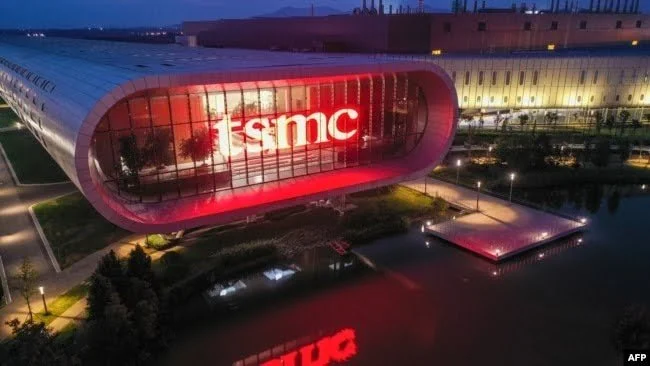
TSMC’s Nanjing Fab (Source: Voice of America, 2023)
Despite efforts by the Taiwanese government to limit reliance on “red supply chains,” Taiwan’s leading technology companies remain deeply integrated into the mainland Chinese economy, and many continue to rely on its manufacturing base as the foundation for its booming technology sector. This is an issue for the People’s Republic of China (PRC) as much as it is for Taiwan, as the companies that have driven Taiwan’s explosive economic growth in recent years also employ millions of mainland Chinese employees and invest substantially in mainland Chinese companies. The trend of cross-strait economic integration has been consistent since China’s Opening-Up and Reform era in the 1980s, when Taiwanese light industry shifted manufacturing operations to mainland China. Even during the Third Taiwan Strait Crisis in 1995, the value of Taiwanese foreign direct investment in and trade with the PRC steadily increased, reflecting a discrepancy between Taiwanese economic ties and security tensions with the PRC that generally persisted until the election of Tsai Ying-wen in 2016.
Among Taiwan’s major corporations, Hon Hai Technology Group (鴻海科技集團) has the most extensive economic integration with mainland China. Hon Hai, better known in the United States by its English name, Foxconn, is the world’s largest contract electronics manufacturer, and is particularly well known as the company most involved in iPhone manufacturing. Despite the widely publicized rise and profitability of Taiwan Semiconductor Manufacturing Company (TSMC), Hon Hai is the largest company in Taiwan by revenue, bringing in around $251 billion in FY2025-26, almost double TSMC, its nearest competitor. It can be difficult to track exactly how much investment a company like Hon Hai makes in mainland China, as cash flows run through Singapore, Hong Kong, and Hon Hai’s mainland Chinese-based subsidiaries. However, according to Hon Hai’s financial records, it owes mainland Chinese banks $60.3 million in long-term loans, 44.5% of all of its long-term loans. It has also loaned $1.27 billion to its subsidiaries in mainland China and invested $3.08 billion in mainland Chinese companies. One of those companies, Contemporary Amperex Technology Co. (CATL), the world’s largest battery manufacturer, has received $1.6 billion in investments from Hon Hai, despite being on the United States Department of Defense’s export control list due to ties with the People’s Liberation Army (PLA). Hon Hai also employs around 529,000 Chinese in the People’s Republic of China (PRC), and 10% of its senior management personnel for factories in the PRC are Chinese nationals.
Although Hon Hai leads Taiwanese companies in its economic integration with the PRC, it is not a unique case. Even major companies with relatively low levels of economic integration with the PRC have difficulty avoiding PRC involvement in their supply chains. TSMC is fundamentally different from a company like Hon Hai because it has much closer ties to the Taiwanese government, its primary individual shareholder, and its primary foreign interest has always been the United States. 75% of TSMC’s revenue in 2025 came from North America, enabling TSMC to remain highly successful despite reduced access to the Chinese market. Still, TSMC operates two major semiconductor manufacturing plants (fabs) in the PRC, and the mainland Chinese market accounted for 9% of TSMC’s annual revenue in 2025, a figure which has remained consistent since 2021 despite pressure from the United States to reduce its ties to the PRC.
Overall, Hon Hai and TSMC exhibit opposite sides of the spectrum of economic engagement with mainland China. However, most Taiwanese companies find themselves somewhere in the middle of this spectrum. A good example of such a company is Wistron. Wistron is a Taiwanese company that focuses on manufacturing information and communications technology. Although not as well known in the United States, Wistron is a Fortune 500 company and the third-largest company in Taiwan by revenue. Wistron’s more balanced approach to US-PRC tensions is reflected in its supply chain and its sales: it is integrated into the mainland Chinese market for power integrated circuits, power supplies, printed circuit boards, and LCDs while relying on the United States for more advanced materials such as CPUs, SSDs, and DRAMs. Wistron relied on 908 mainland Chinese suppliers for 34.2% of its purchases in 2024, in contrast with 84 North American suppliers accounting for 1.42%. However, Wistron’s sales to the United States account for 70.65% of its total sales from exports, in contrast to 3.66% from mainland China. Further, Wistron announced in 2025 that it would invest $761 million to construct its first US-based manufacturing facility in Fort Worth, Texas. Having started operations on July 21, 2026, it will now produce “NVIDIA’s most advanced and cutting-edge products,” including the NVIDIA GB300 Grace Blackwell Ultra Superchip and the soon to be released NVIDIA Vera Rubin Superchip. Put together, these datapoints reflect Wistron’s intent to sustain engagement with both the US and the PRC and the centrality of both to their business model.
However, Taiwanese firms are not confronted with a simple binary choice between the U.S. and the PRC. In response to US-PRC tensions, Wistron has expanded its manufacturing capabilities into countries such as Mexico and Vietnam, investing hundreds of millions to build new factories. Hon Hai has also invested heavily to expand its operations in Vietnam, the Czech Republic, India, and of course, Taiwan itself. These diversification efforts have yielded mostly positive results, but notable failures remain, particularly for Hon Hai, whose major projects have faced difficulties or outright collapse in the United States and India. Hon Hai in particular faces pressure from the PRC to not move operations outside the PRC, demonstrated by a recent episode in which Hon Hai withdrew 300 engineers from an operation in India after public criticism from Beijing.
The economic integration between the PRC and Taiwan plays a vital role in diplomatic relations between the two nations. Despite political pressure within the Communist Party of China (CPC) to invade Taiwan, the close economic ties between them elevate costs for both sides in a cross-strait contingency. Further, economic ties contribute to closer personal ties between mainland Chinese and Taiwanese communities, with more than 230,000 Taiwanese working in mainland China. This is part of why around 91% of the Chinese public has favorable views of the Taiwanese people separate of the Taiwanese government, adding to the potential costs of a cross-strait conflict. Understanding cross-strait economic ties is essential for U.S. policymakers because the relations between the PRC and Taiwan cannot be understood solely through the lens of strategic rivalry. There is a deeper, more complex relationship between the two, and underlying factors such as close economic ties might drive new policies that the United States will not be able to foresee without an understanding of those forces.